Margaret Woodward: Introduction
Dr Julie Cotter
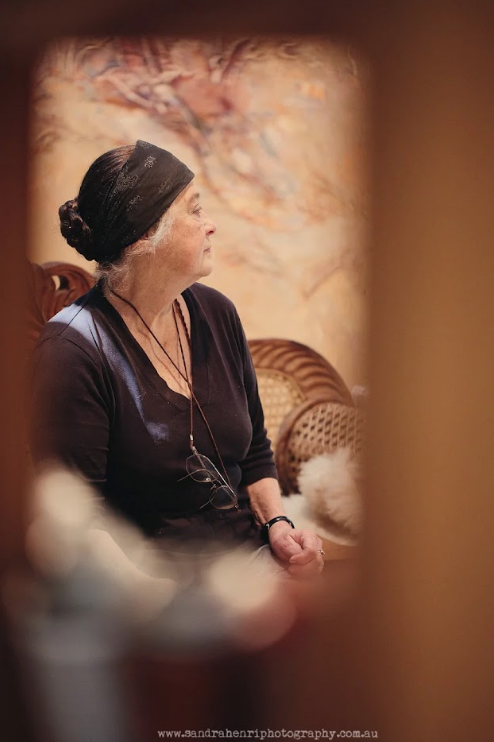
Photography: Sandra Henri, 2015.Margaret Woodward’s paintings, produced during forty years of assiduous dedication, are complex, beautiful, mystifying and deeply personal. She travelled into the outback of Australia and the streets of Paris, all subject matter for her work, yet many of her paintings emanate from the inner world of her studio. She employed her unbounding imagination to bring people, objects and landscapes to life. She read the books of philosophers and religious scribes alongside the work of French theorists infusing her work with the sensibilities of their investigations. It was all part of her personal journey expressed in both the application of paint to canvas and her meticulous dark and probing drawings, many large in scale and heroic in nature.
Born in 1938 in Sydney, Margaret was awarded the accolade of first in the state of NSW for Leaving Art in 1955, her school reports, held in the AGNSW archives, containing expressions of admiration on the part of her art teachers for her talent. Indeed, she was a high performing student in many areas, yet her talent for art was obvious.
Margaret embarked upon a career as an artist, studying at the National Art School, her early influences ranging across the spectrum of modernist art. And there was her obsession with colour. She once explained her painting process and the order of colours on her palette. “I might mix five steps between them. Each step can then be mixed with a third colour to give another series of transitional steps. The colours must be mixed cleanly with a palette knife,” she declared.
Also impactful were the paintings of her teachers, particularly landscapes by John Passmore and John Olsen. Their influence is evident in Margaret’s immersive landscapes, her early Cezanne-styled patterning and colour, and her response to the richness of the Australian desert and lush vegetation.
Margaret was a longtime Francophile, influenced by her father who had studied at the Sorbonne and was a Professor in French at Sydney University and who often included Margaret on his French radio programs. French words can often be found scribbled on the side of her paintings. Needing to discover European art firsthand, with her young daughter Britt, she embarked on an artistic voyage of discovery in 1967. When Britt became ill during the voyage, Margaret spent the extended time in England and Europe observing the works of Rembrandt and Velazquez who became lifelong muses.
“Margaret embarked upon an art career during a period when the galleries, critical reviews and buying public were largely dominated by men. Undaunted, she began submitting work to art prizes while still young, winning the Wynne Prize in 1971 and exhibiting her work widely.”
Margaret embarked upon an art career during a period when the galleries, critical reviews and buying public were largely dominated by men. Undaunted, she began submitting work to art prizes while still young, winning the Wynne Prize in 1971 and exhibiting her work widely. When offered a teaching position at the Western Australian Institute of Technology she packed up Britt and her art materials and moved to Perth from 1972 to 1978, the impact of the changed landscape evident in her work.
Moving back to Sydney in 1979, she embarked upon a period of intense activity. She won the Portia Geach Memorial Award in 1983 and 1984 and was an Archibald finalist seven times. It was a prize rarely awarded to women, the impenetrable nature of the male art world exasperating Margaret, her Archibald entry for 1987 a self-portrait accentuated by scribblings documenting her lifetime, her associations and her credibility as an artist. Indeed, by 1987 she was considered an important and knowledgeable figure in the art world. Regularly asked to participate in judging panels, review art courses, provide commentary on issues, she had also, by this time, amassed a sizeable body of work.
Margaret travelled widely and to places that jolted artistic responses and pleasure in the landscape and the people she encountered. Java and Fiji, then Kenya, Zimbabwe and South Africa treading in the footsteps of Richard Leakey and meeting Mary Leakey, while also exploring remote parts of Australia including Arnhem Land, Elcho and Melville islands of the Northern Territory alongside artists Robert Juniper and Max Miller. Welcomed into the aboriginal communities, they worked to gain a deep understanding of the culture and importance of the sacred sites of the country. Margaret favoured the spectacular nature of Australia’s country and often explored the Bungle Bungle Range and the Warrumbungle National Park in her paintings.
The works shown on this website are drawn from Margaret’s private studio collection. Many are portraits, most explore her inner musings from a deeply considered perspective and others provide a view of an Australian landscape from a unique and masterly perspective.