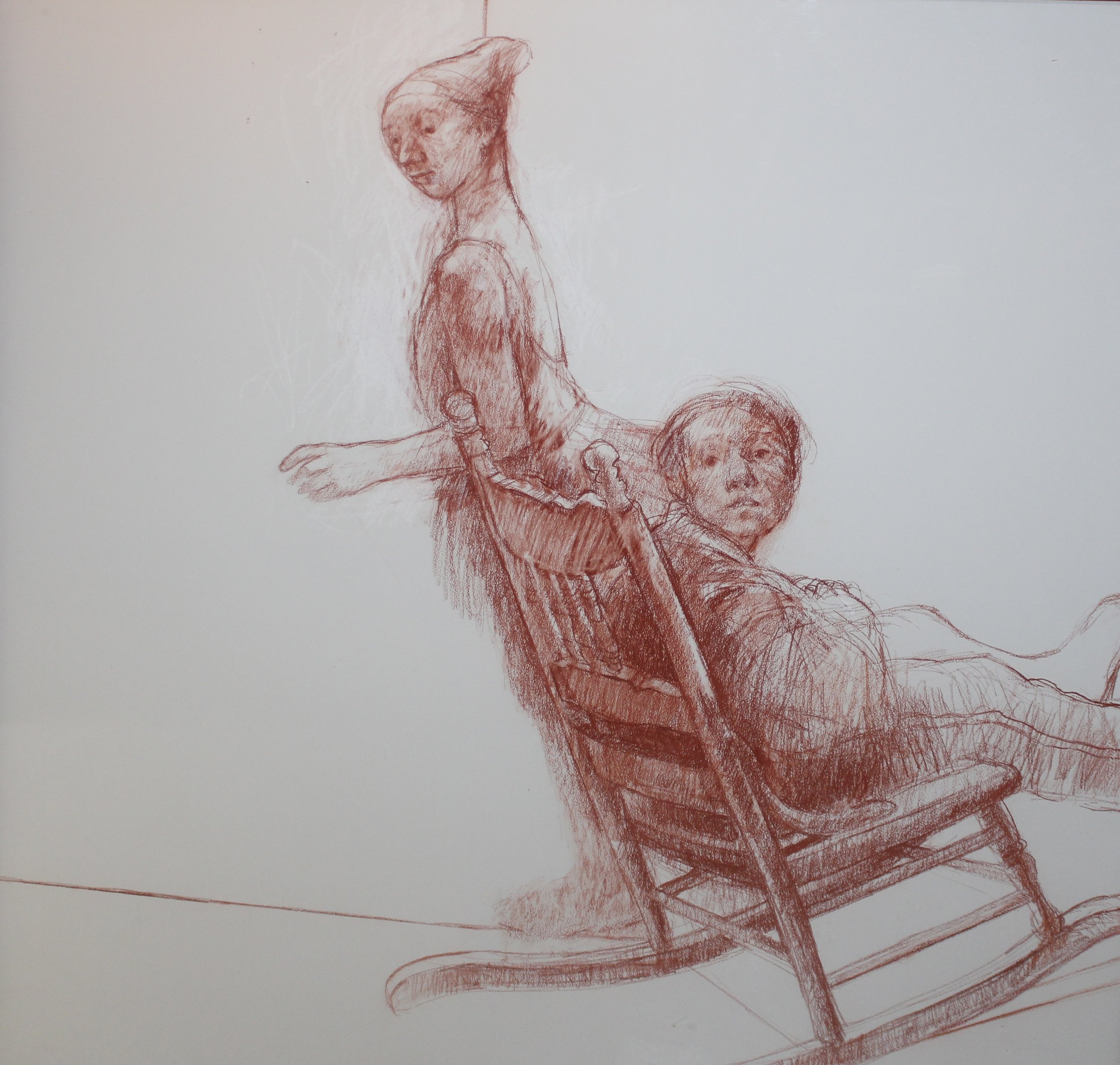
'Francisco and the Little Dancer', 2008, pastel on lam canvas, 150 x 150cm.Margaret Woodward
Francisco and the Little Dancer
(2008)
Margaret uses red crayon for this drawing, a medium she regularly adopted during this period. Francisco is seated in a rocking chair, a studio prop she often employed in her work and is found in at least one of her self-portraits, The Rocking Chair. Sitting in the rocking chair allowed Margaret to analyse the works in progress in her studio, at times “imagining what I already know of the subject in my imagination into the space”. The dancer is behind Francisco yet seemingly blends into his figure. Strangely Francisco swerves to look at us, the viewer, as though he has been caught out while the dancer maintains her “dancer’s pose”.
There is a sense of Francisco asking a question of Margaret’s intent, is she comparing his seated figure with the agility of the dancer or just contemplating their connection? It is the blending of the two figures that is particularly of interest.
The work goes to the heart of Margaret’s continual assertion of the complexity of her art practice, that nothing is as it seems, to assume one position or interpretation of a work is to deny many others.
The work goes to the heart of Margaret’s continual assertion of the complexity of her art practice, that nothing is as it seems, to assume one position or interpretation of a work is to deny many others.
The figure of Francisco is most likely that of Francisco Lezcano depicted many times by Margaret. The subject was taken from Velazquez’ portrait, 'El Niño de Vallecas', and became a favourite for Margaret, the subject appearing in many portraits and studies. Francisco lived with dwarfism, Margaret finding within his story an opportunity to address disability and seek an emotional intensity, wanting to observe his inner life.
The dancer was an equally popular subject for Margaret, her beauty and agility depicted in many canvases. Sketching ballet dancers was a favourite pastime, sitting in on dance rehearsals including those of the Australian ballet, quietly observing and creating, sketchbooks filled with drawings that follow their grace and suppleness. Many of these remained as sketches but there are some such as this drawing and Strippers Dance in Memory of Henri that show her observations in a formal work.
The dancer in this work is refined and elegant in her pose- the straight back, tilt of the head and coquettish gaze downwards suggesting years of practice. It is not a natural pose of the body but one that highlights the result of the trained figure, the hand gesture a sign of movement, the body poised to begin. She is the future while Francisco, drawn out from the past, is seated as the inspiration.
Exhibitions and competitions:
“Margaret Woodward - Paintings and Drawings” - Wagner Art Gallery, Paddington, NSW, 18 September - 14 October 2010.
References:
Margaret Woodward quoted in Drawn Together, Parramatta, Parramatta City Council, c2005, p.64.