May 2026
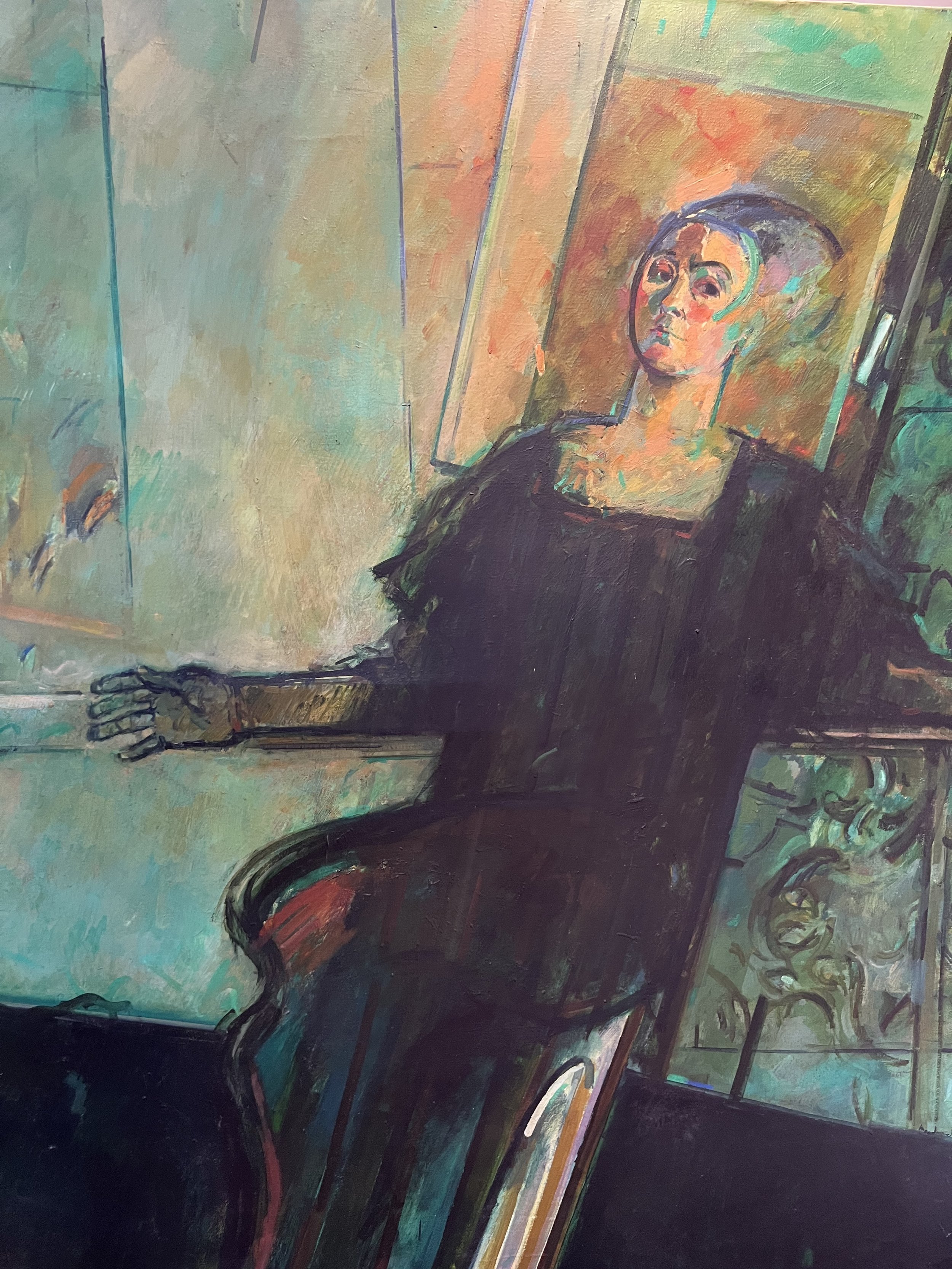
Self-portrait, 1980, oil on canvas, 187 x 187cm.Welcome to the Margaret Woodward website. Here you will find images and stories about many of Margaret’s paintings plus we will update you on relevant exhibitions and any other information related to Margaret and her wider network.
With the announcement of the 2026 Archibald Prize winner, it is timely to look at Margaret Woodward’s entries to the highly coveted prize. Her first submission to the Archibald was in 1970 with the work Self-portrait with Britt, a painting that explores her relationship with her young daughter. It was the first of seven short-listed entries in total over fourteen years for Margaret, yet her hard work was never rewarded with the Archibald. She did, however, have success with the Wynne Prize in 1971, matched by her inclusion in several prestigious group exhibitions and one woman shows at both the Holdsworth Galleries in Sydney and the Greenhill Galleries in Adelaide – and success twice with the Portia Geach Memorial Award.
Portraiture was Margaret’s first love, the genre eclipsing others from an early age, and she spent many years developing her skills. Her research included a commitment to life drawing as well as studying the work of Rembrandt and Velazquez, two of her favourite painters. Like many women artists, her favourite subject for the Archibald was herself, the difficulty in attracting high profile subjects as well as competing priorities of work and motherhood made finding time for portrait sittings not easy.
For the 1980 Archibald Prize Margaret chose to enter Self-portrait and was included as one of 30 shortlisted works. Famously, the newly appointed trustees considered that there were no worthy entries amongst the shortlist and did not award the Prize. The Bulletin described Margaret’s work as a ‘haunting self-portrait’, Margaret ‘wispily shy, nervously anguished, yet radiating an inner strength. A human being is captured here, not a glossy impersonal image.’
The entry exhibits an experimentation with technique, positioning of the figure within the picture plane and wariness of placing the focus upon herself. The work also explores her ability to create vibrant hues, the background colours clean, providing a halo for her central figure.
Of course, the odds for a win were not in Margaret’s favour. By 1980, the only women to win the Archibald since its establishment in 1921 were her friends Nora Heysen and Judy Cassab as well as success by Janet Dawson in 1973.
References
The Bulletin, March 1981, p.78.