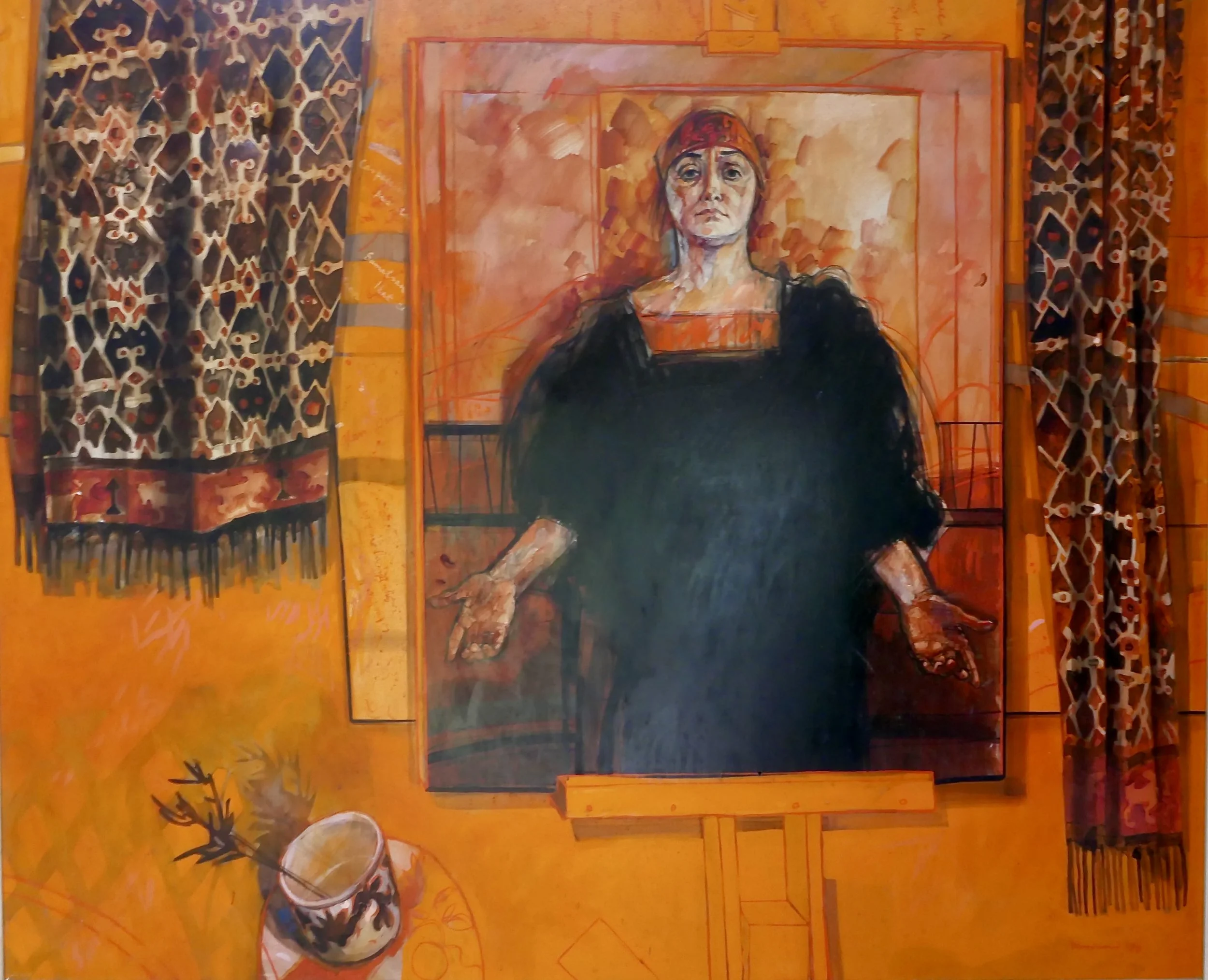
'Self-Portrait within a Portrait', 1987, oil on canvas, 180 x 215cm; 207 x 240cm (framed).Margaret Woodward
Self-Portrait within a Portrait
(1987)
This extraordinary self-portrait was entered in the Archibald Prize for 1987, the annotation written on the back of the canvas. It was not shortlisted. Margaret is central to the work, surrounding her image with a series of scribbles relevant to past life events. The self-portrait painted within the larger canvas shows Margaret standing with her hands open to the viewer – the pose often depicted in Christian imagery, a Jesus style of pleading – why hath thou forsaken me? Margaret’s face in the portrait is stern and questioning, uncompromising as was her personality. The colouring is a vibrant orange not often seen in Margaret’s work, the colour chosen to position the subject directly within the viewer’s line of sight.
On both sides of the painted self-portrait are strung two pieces of patterned fabric often found in Margaret’s work, whether hanging over a railing in Dunes and Small Dog Between the Lake and the Sea (1989, pastel), the fabric providing a connection to her studio or included in her figure studies such as Reclining Figure with Ikat Cloth (1989, pastel). The Ikat cloth frames and encloses Margaret within the self-portrait, the traditional cloth from south east Asia symbolising fine artisan work and Margaret’s connection to the integrity of making. The cloth remains hanging in her studio, one of the few decorative props that she treasured.
That they continued to exhibit, to front up with works grand and significant in their essays of life, with their portraits of fellow women who had equally achieved, was testimony to their resilience.
In 1987 Margaret Woodward was 49 years old, mid-career, had won some prizes and received acknowledgment for her work but the accolades did not compare to those bestowed upon the male artists of the time, Brett Whiteley and John Olsen the favoured contemporaries. Of the 26 artists short listed for the Archibald from the 300 entries in 1987, only six were women and by 1987 only four women in the history of the Archibald had been announced the winner. Two of these winners, Judy Cassab and Nora Heysen, were Margaret’s close friends.
Margaret’s Self-Portrait within a Portrait may very well be asking why not me? The winner in 1987 was a rather quixotic self-portrait by William Robinson on his prancing horse. It is hard to imagine the disappointment of having such a grand self-portrait rejected, having bared her soul to colleagues, yet Margaret was one of the many who had to turn up at the AGNSW side entrance to retrieve her painting, to bring it back to the studio and ponder its failure. While that is the gauntlet run by all prize entrants, the percentage of women artists who were forced to deal with failure far outweighed that endured by men. That they continued to exhibit, to front up with works grand and significant in their essays of life, with their portraits of fellow women who had equally achieved, was testimony to their resilience.
References
Margaret Woodward, Dunes and small dog between the lake and the sea (1989, pastel), Art and Australia, v.27 n.2, Summer 1989, p.373.